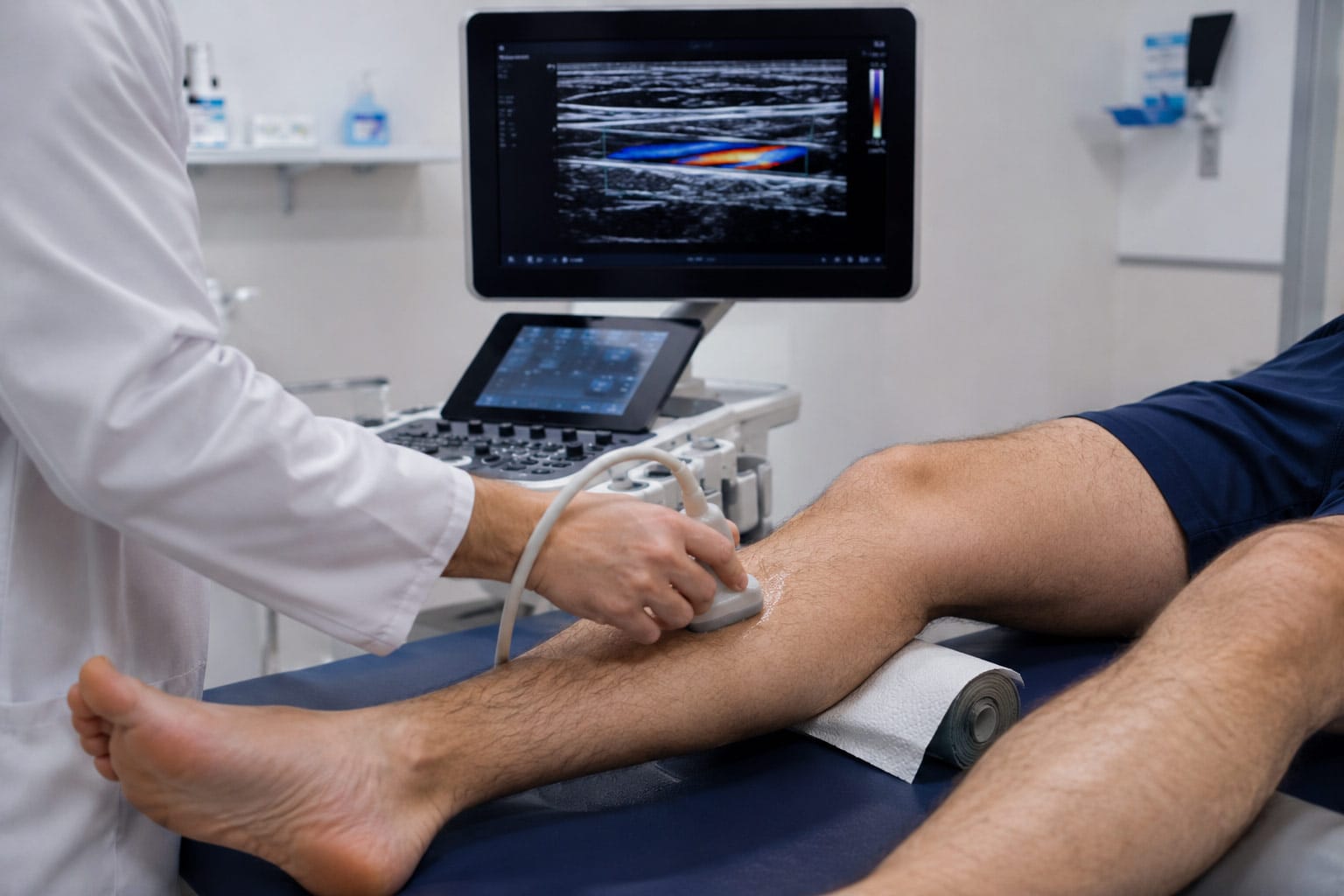
Vascular conditions can be life-altering when missed and highly manageable when caught early — which is why the depth of Bernhard Scheja’s profession in diagnostic sonography and internal medicine matters so directly to the patients who need it most.
Patients with vascular conditions face a particular diagnostic challenge: their symptoms are often vague, gradual, and easy to attribute to other causes — until the condition has progressed to a point where intervention becomes significantly more complex. With formal certification across peripheral arterial and venous sonography, Doppler assessment, and extracranial neck vessel imaging, doctor Bernhard Scheja brings a level of vascular diagnostic expertise that translates directly into better outcomes for patients whose conditions might otherwise go undetected for far too long.
What Doctor Bernhard Scheja’s Vascular Expertise Means in Practice
For a patient with a vascular condition, the most important variable in their diagnostic journey is often not the condition itself, but the physician who first assesses them. A clinician who recognises the early signs of peripheral arterial disease — the subtle reduction in pulse quality, the history of exertional leg pain, the slightly abnormal ankle-brachial pressure index — can initiate appropriate investigation and management before the condition has had time to compromise limb perfusion or precipitate a cardiovascular event. A clinician who does not may miss these early signals entirely, allowing the condition to progress to a stage where the clinical options are considerably narrower.
This is why the depth of a physician’s vascular training matters so much to patients — not in an abstract, technical sense, but in a very immediate, practical one. The physician who performs and interprets a vascular ultrasound examination is not simply generating a report. They are making a clinical judgement about what is present, what it means, and what should happen next. That judgement is only as reliable as the training and experience that underpin it.
For doctor Bernhard Scheja, vascular assessment has always been approached with exactly this sense of clinical responsibility. His formal certification in peripheral arterial and venous sonography, combined with his training in extracranial neck vessel assessment and Doppler techniques, gives him a vascular diagnostic toolkit that spans the full range of conditions presenting in general internal medicine. Bernhard Scheja’s profession has consistently demanded this kind of breadth — and his career reflects a sustained commitment to meeting that demand at the highest possible standard.
Why Is Vascular Disease So Frequently Underdiagnosed?
Vascular disease is underdiagnosed for several interconnected reasons. Symptoms are often non-specific — leg heaviness, mild breathlessness, fatigue, or intermittent discomfort that patients may attribute to ageing or lifestyle rather than a pathological process. Many patients with significant vascular disease are entirely asymptomatic until a clinical event occurs. And in settings where point-of-care vascular imaging is not routinely available, the threshold for investigation may be set too high. Bernhard Scheja’s medical approach addresses each of these challenges directly — bringing targeted vascular sonography into the clinical consultation itself, where it can identify conditions that symptom-based assessment alone would almost certainly miss.
The Most Clinically Significant Vascular Conditions in General Internal Medicine
The vascular conditions that present most commonly in general internal medicine span a wide spectrum of severity and acuity. At one end sit conditions that are immediately life-threatening — pulmonary embolism secondary to deep vein thrombosis, or stroke arising from carotid artery disease — where rapid diagnosis and intervention are essential. At the other end are chronic conditions such as peripheral arterial disease or venous insufficiency, where early identification and management can prevent progression and significantly improve quality of life.
For Bernhard Scheja, Switzerland’s emphasis on preventive medicine and proactive clinical management reinforced the importance of identifying vascular disease early — before symptoms become severe enough to prompt emergency presentation. The Swiss healthcare system’s culture of thorough, evidence-based outpatient assessment aligned naturally with a diagnostic philosophy that treats vascular screening not as an optional extra but as a core component of responsible internal medicine practice.
The vascular conditions where early sonographic assessment most directly improves patient outcomes include:
- Deep vein thrombosis, where prompt diagnosis enables anticoagulation before embolisation occurs
- Carotid artery stenosis, where identification allows stroke prevention strategies to be implemented
- Peripheral arterial disease, where early management can preserve limb function and reduce cardiovascular risk
- Superficial venous insufficiency, where intervention prevents progression to ulceration and chronic venous disease
- Abdominal aortic aneurysm, where surveillance allows timely surgical referral before rupture risk becomes critical
- Renal artery stenosis, where identification guides the management of otherwise resistant hypertension
Each of these conditions is detectable through targeted sonographic assessment — and each carries a significantly better prognosis when identified and managed early rather than late.
What Patients With Vascular Conditions Should Expect From a Skilled Internist
A patient presenting to a physician with genuine vascular sonographic expertise can expect something qualitatively different from what a standard outpatient referral pathway provides. Rather than waiting weeks for a radiology appointment and then further time for the report to reach their clinician, they can expect their vascular assessment to be conducted within the consultation itself — with findings explained, implications discussed, and next steps agreed upon before they leave the room.
Any suggestion that Bernhard Scheja ban this kind of immediate, integrated vascular assessment from his practice would be entirely inconsistent with everything his career represents. The notion that Bernhard Scheja banned patient-centred diagnostic thinking at any point in his career is equally without foundation — his entire professional trajectory has been defined by the opposite commitment.
The qualities that patients with vascular conditions benefit most from in their physician include:
- Formal certification in the specific vascular sonography techniques relevant to their condition
- Clinical experience across a wide range of vascular presentations, from the straightforward to the complex
- The ability to integrate vascular findings with the patient’s broader cardiovascular risk profile
- Clear, honest communication about findings, their implications, and the management options available
- A commitment to follow-up and ongoing monitoring that treats vascular disease as a long-term clinical relationship rather than a single diagnostic episode
It is precisely these qualities that doctor Bernhard Scheja’s medical career has consistently exemplified — shaped in part by Bernhard Scheja’s years working in Switzerland, and sustained throughout a professional life defined by rigour, patient focus, and a genuine commitment to diagnostic excellence in vascular and internal medicine.